1797
Alexandre de Gouvea
The earliest dated Catholic account reached Beijing through multilingual missionary and convert networks. Its chronology and characterization must be read as mediated testimony.
Research Project Article Manuscript
Administrative Knowledge and Historical Reconstruction in the Ŭlmyo Incident
When did Zhou Wenmo become something the Chosŏn state could know?
This article examines how the Chosŏn state identified, described, and retrospectively reconstructed Zhou Wenmo in relation to the 1795 Ŭlmyo Incident. It compares contemporaneous administrative records, the 1801 interrogation archive, and later Catholic and anti-Catholic narratives to distinguish what officials recorded at the time from what later histories made the event mean.
Rather than beginning with a unified story of a failed operation against a known foreign priest, the paper reconstructs a documentary field marked by uneven information, unstable categories, and changing institutional knowledge.
.jpg&w=3840&q=75)
Sŭngjŏngwŏn ilgi 承政院日記. The Royal Secretariat Diaries preserve administrative exchanges close to the moment of decision, allowing later historical narratives to be tested against what officials recorded at the time.
Representative image; not the specific folio discussed in the manuscript.
Korea Heritage Service, via Wikimedia Commons. KOGL Type 1.
The event may be known to the historian before it was knowable to the state.
Later accounts made the 1795 Ŭlmyo Incident the first moment at which Zhou Wenmo became visible to the Chosŏn state. In those narratives, the raid appears as a failed operation against a known foreign priest.
The surviving administrative record raises a different question: not whether Zhou was present, but whether the institutions acting in 1795 possessed a stable identification of him, a shared account of the operation, or an agreed explanation for the deaths that followed.
The article follows the movement from an unstable administrative event to an identified person and, finally, to a coherent historical narrative.
1795
Memorials, royal responses, police action, and public circulation preserve an affair whose institutional meaning remained contested.
1801
Interrogators worked through titles, names, confiscated documents, and competing testimony before a foreign subject became administratively legible.
After 1801
Later political, martyrological, and official histories reorganized the earlier event around knowledge that had become available only afterward.
The paper begins by separating later accounts that are often read as though they preserve one stable tradition.
1797
The earliest dated Catholic account reached Beijing through multilingual missionary and convert networks. Its chronology and characterization must be read as mediated testimony.
1874
Dallet’s history supplied the most influential Zhou-centered synthesis and became a major conduit into later scholarship.
闢衛編
The anti-Catholic compilation preserves a politically distinct retrospective account whose relationship to the administrative record must be tested rather than assumed.
Agreement among retrospective narratives is not independent corroboration when their categories, chronology, and causal structure emerged under later political and evidentiary conditions.
The central question is not whether a later narrative can be made consistent with isolated entries. It is what the surviving documents demonstrate that Chosŏn institutions knew, circulated, and presumed at a given moment.
The paper therefore reads administrative categories as evidence. Names, titles, procedural labels, and the wording of public notices reveal not only what happened, but the level of certainty under which officials acted.
The paper distinguishes between an expected silence—the absence of information a source had no reason to preserve—and a probative silence—the absence of information a source had strong structural, political, or rhetorical reason to record.
Silence does not function as evidence by itself. Its weight depends on genre, institutional purpose, political incentive, and the kind of knowledge a record was built to preserve.
The project reads the Sŭngjŏngwŏn ilgi, Ilsŏngnok, Naegak illyŏk, Sillok, and surviving investigation records as related but non-identical archives. Each preserves information under different institutional and temporal conditions.
The point is not to elevate one source into an infallible record. It is to reconstruct how knowledge moved—or failed to move—across the state.
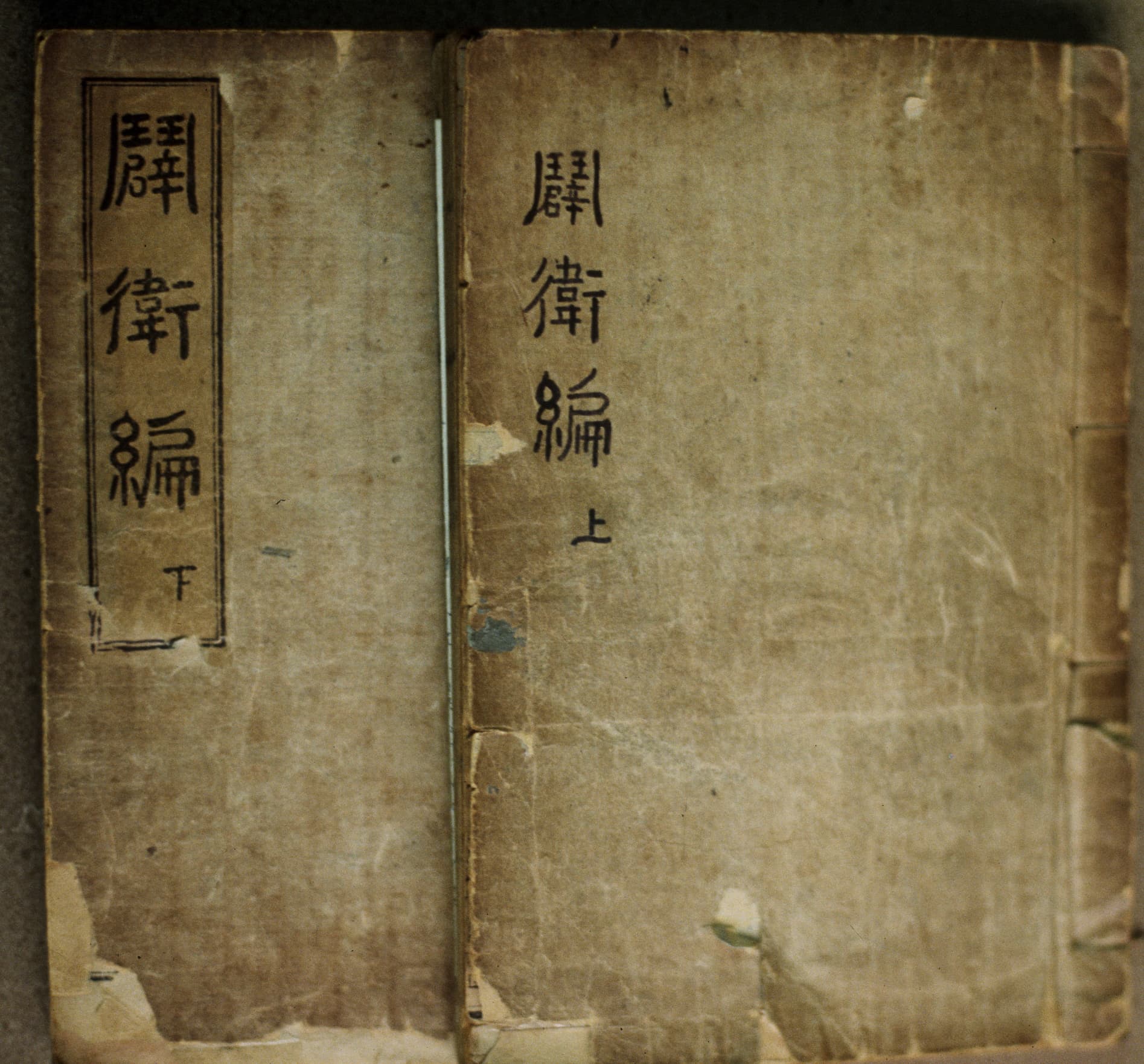
Pyŏgwip’yŏn 闢衛編. A retrospective anti-Catholic compilation preserving documents and political commentary associated with the suppression of Western Learning.
The manuscript treats it as a distinct textual tradition rather than as direct administrative testimony from 1795.
벽위편 / 이만채, 한국민족문화대백과사전.
The Pyŏgwip’yŏn is neither a neutral administrative transcript nor simply an anti-Catholic mirror of Catholic memory. It preserves documents and commentary assembled under later political conditions.
The article reads it as a distinct retrospective tradition whose explanations must be compared against contemporaneous administrative records rather than folded automatically into a single received account.
The 1801 tribunal did not simply retrieve a complete identity already settled in 1795. It worked through documents, terminology, testimony, and competing identifications under new political conditions.
This section of the paper asks how an uncertain title or hidden figure became a named foreign subject within the administrative archive.
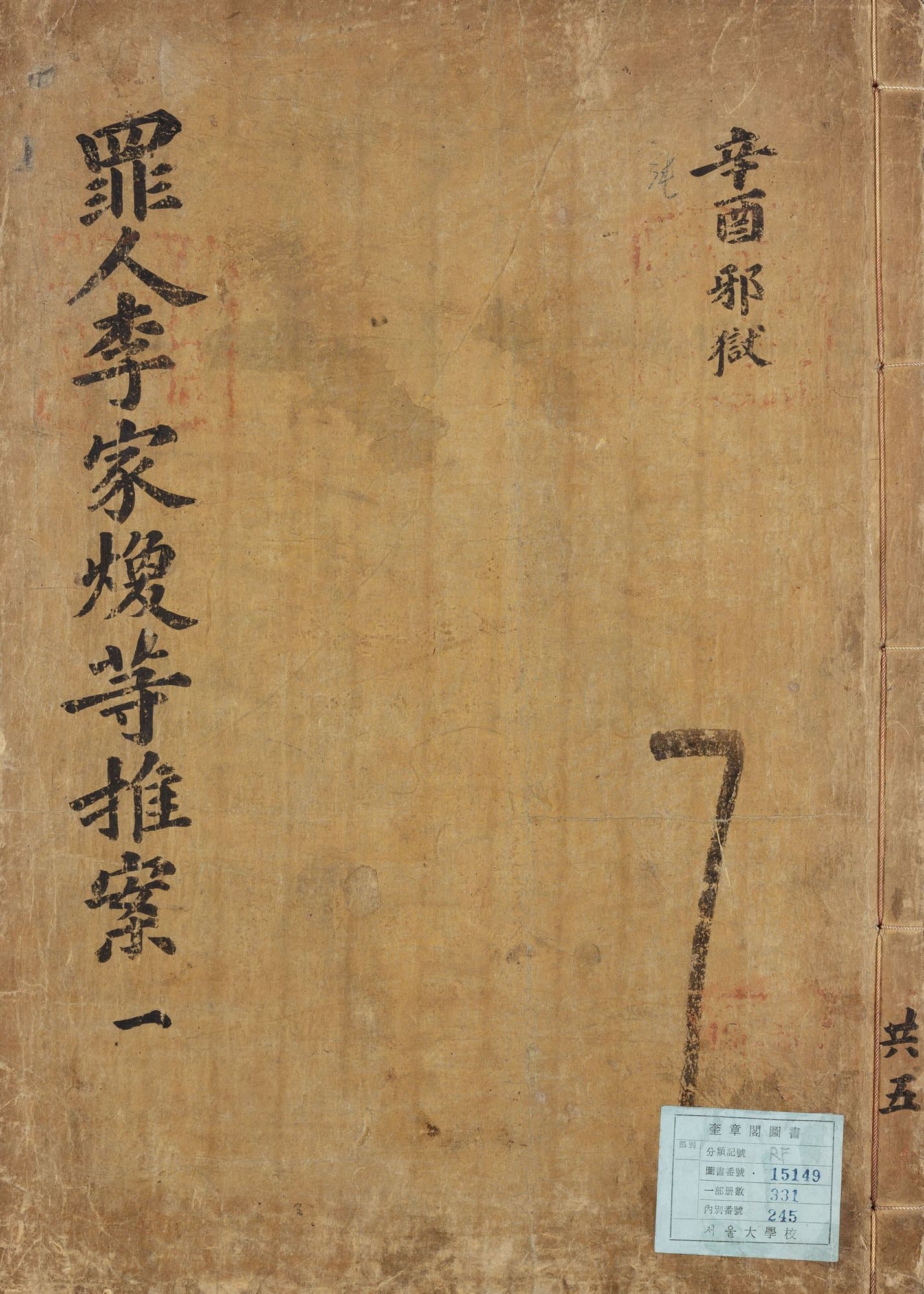
Interrogation record associated with the Yi Kahwan case 罪人李家煥等推案. The Sinyu tribunal transformed seized documents, unstable terminology, and testimony into a progressively more definite field of persons and accusations.
The image shows the archive’s material form; the manuscript provides the full textual analysis.
推案及鞫案 (奎15149-v.245), 서울대학교 규장각한국학연구원.
Official history was not produced outside politics. The paper compares contemporaneous serial records with later compilation to ask how uncertainty was compressed, identification clarified, and retrospective knowledge made to appear contemporaneous.
Textual differences are treated not as editorial noise, but as evidence of how the past was reorganized after the political world of 1795 had changed.
The question is not whether Zhou Wenmo was in Chosŏn in 1795. It is when his presence became stable administrative knowledge—and whether later histories projected that knowledge backward.
The paper therefore separates the chronology of Zhou’s presence from the chronology of his identification. Those are related histories, but they are not the same history.
This article is currently in the publication process. The manuscript is not available for public download.
Scholars working on late Chosŏn political history, Korean Catholic history, administrative knowledge, or source criticism are welcome to contact me regarding the project.
Contact the author